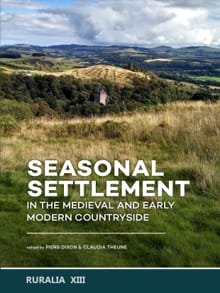
Seasonal Settlement in the Medieval and Early Modern Countryside
For the first time seasonality is placed at the centre of the study of rural settlement. Using a Europe-wide approach, it provides a primer of examples, of techniques and of ideas for the identification and understanding of seasonal settlement. As such, it marks an important new step in the interpretation of the use of the countryside by historic communities linked to the annual passage of the year. The particular studies are introduced by an opening essay which draws wider conclusions about the study of seasonal settlement, followed by 31 papers by authors from all parts of Europe and beyond. By its very nature ephemeral, seasonal settlement in the medieval and early modern periods is less well researched than permanent settlement. It is often presumed that seasonal settlement is the result of transhumance, but it was only one facet of seasonal settlement. It was also necessitated by other forms of economic activity, such as fishing, charcoal-burning, or iron-smelting, including settlements of pastoralists such as nomads, drovers, herders as well as labourers’ huts within the farming context. The season a settlement was occupied varied from one activity to another and from one place to another – summer is good for grazing in many mountainous areas, but winter proved best for some industrial processes. While upland and mountainous settlements built of stone are easily recognised, those that use wood and more perishable materials are less obvious. Despite this, the settlements of nomadic pastoralists in both tundra and desert or of fishermen in the Baltic region are nonetheless identifiable. Yet for all that definitive recognition of seasonal settlement is rarely possible on archaeological grounds alone. Although material remains can be of particular importance, generally it is the combination of documentary information, ethnography, geographical context and palaeo-environmental data that provide frameworks for interpreting seasonal settlements. Contents: Foreword Piers Dixon and Claudia Theune SECTION ONE: SEASONAL SETTLEMENT AND MEDIEVAL ENVIRONMENT Seasonal settlement in rural archaeology as a research question Piers Dixon Too much environment and not enough history: the opportunities and challenges in researching seasonal settlement in Atlantic Europe Richard Oram SECTION TWO: SEASONAL SETTLEMENT IN SOUTHERN EUROPE Archaeological research on seasonal settlement in the south-west part of Europe – an overview Caterina Tente and Margarita Fernandez Mier Archaeological research into seasonal settlement in a medieval and early modern countryside landscape in East-Tyrol, Austria Elizabeth Waldhart A multi-disciplinary approach to the relationship between seasonal settlements and multiple uses: case studies from southern Europe (10th-21st Century) Anna Maria Stagno Transhumance in medieval Serbia Ugljesa Vojvodic Multi-functionality of grazing areas in the Cantabrian Mountains Margarita Fernandez Mier and Pablo Gomez Ploughs, herds and chafurdões: vernacular architecture and land-use in modern Castelo de Vide (Alto Alentejo, Portugal) Fabián Cuesta-Gómez and Sara Prata From Roman villa rustica to modern farmers grange – the specific way of seasonal settlements in eastern Croatia Anita Rapan Papesa and Pia Smalcelj Novakovic SECTION THREE: SEASONAL SETTLEMENT IN NORTHERN AND EASTERN EUROPE Seasonal settlement in Wales Rhiannon Comeau and Bob Silvester Seasonal upland settlement as an indicator of ‘glocalisation’ in rural northern Europe, c.1350-1850 Eugene Costello Seasonal and/or permanent? Entangled flexibility in the Scandinavian forested mountains Eva Svensson Upland habitation at Castle Campbell in the Ochils, Scotland: a multi-functional historic landscape at Dollar Glen Daniel Rhodes Palynological data on vegetation and land use change at a shieling ground on Ben Lawers, Central Scottish Highlands, since the 13th century AD Richard Tipping From seasonal settlement to medieval villages? The early medieval settlement in...
- Uitgeverij
- Sidestone Press
- Imprint
- Sidestone Press Academics
- Uitgegeven als
- Paperback • Hardcover
- Eerste editie
- 13-09-2021
- Laatste editie
- 15-09-2021
- ISBN
- 9789464270099 • 9789464270105
- Aantal pagina's
- 330
- Serie
- Ruralia
- Taal
- Engels
Populair in hetzelfde genre